
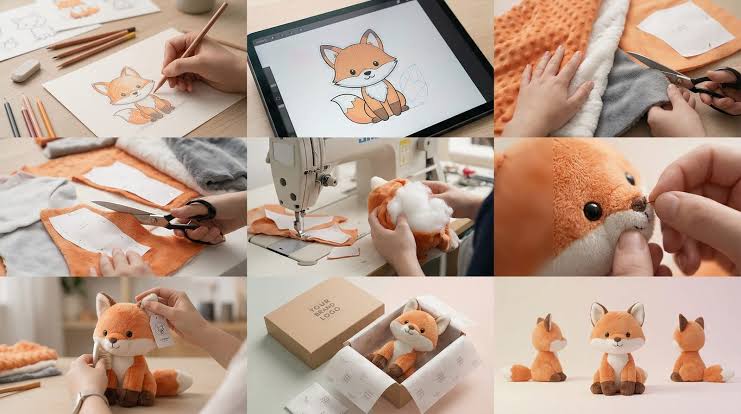

Starting a plush toy brand can be exciting, but turning an illustration or character concept into a production-ready product requires careful planning. From choosing the right fabric and filling to creating samples, testing safety, setting minimum order quantities, and managing production costs, every decision can affect the final product.
For startups, plush toy manufacturing is often more challenging than it first appears. You may have a great character design, but a successful plush product also needs the right construction, materials, proportions, stitching, safety features, packaging, and manufacturing process.
This guide explains the key steps involved in plush toy manufacturing for startups and provides practical advice for working with a custom plush toy manufacturer.
Why Plush Toys Are a Good Product for Startups
Plush toys are highly adaptable products. A simple character can be developed into stuffed animals, collectible plush toys, keychains, cushions, pillows, mascots, backpacks, or seasonal products.
They are also suitable for many types of businesses, including:
- Character and IP brands
- Children’s brands
- E-commerce businesses
- Kickstarter projects
- YouTube and social media creators
- Gaming and entertainment companies
- Gift companies
- Pet brands
- Promotional businesses
- Fashion and lifestyle brands
For startups, one of the biggest advantages is that a plush character can become a long-term brand asset. Once the first product is successful, the same character can be developed into different sizes, colours, accessories, and related products.
However, startups should avoid ordering large quantities before confirming that the design, quality, pricing, and market demand are all suitable.
Step 1: Prepare Your Plush Toy Design
The manufacturing process normally starts with a design.
Your manufacturer may receive a professional 3D model, a character illustration, a hand-drawn sketch, or even a simple reference image. You do not necessarily need a finished manufacturing pattern before contacting a factory.
A professional plush toy manufacturer can usually help convert a 2D concept into a three-dimensional plush toy product.
Useful information to provide includes:
- Front, side, and back views
- Character dimensions
- Target finished size
- Preferred colours
- Fabric references
- Embroidery details
- Eye and nose design
- Accessories
- Intended use
- Target retail price
- Estimated order quantity
The more information you provide, the easier it is for the manufacturer to understand your expectations.
If your design is only an illustration, ask the manufacturer whether they provide plush toy design and pattern development. This can save startups considerable time during product development.
Step 2: Choose the Right Materials
Material selection has a major impact on the appearance, softness, durability, and cost of a plush toy.
Common outer fabrics include:
Minky Fabric
Minky is soft, smooth, and popular for premium plush toys. It provides a comfortable hand feel and works well for characters with a clean, modern appearance.
Velboa
Velboa is widely used for commercial plush toys because it is relatively economical and available in many colours and pile lengths.
Faux Fur
Faux fur is useful when the character requires a realistic or fluffy appearance. Long-pile and short-pile options can create very different visual effects.
Fleece
Fleece is soft and flexible and can work well for simple character designs, blankets, cushions, and certain promotional plush products.
The filling is equally important. Polyester fibre filling is one of the most common choices because it is lightweight, soft, and relatively easy to process.
Startups should discuss fabric, filling, colour, softness, density, and durability with the manufacturer before approving the final sample.
Step 3: Develop a Prototype Sample
Never move directly from artwork to mass production.
The prototype or first sample allows you and the manufacturer to identify problems before committing to a large order.
During sample development, the factory creates patterns based on the approved design and produces an initial plush sample.
You should carefully check:
- Overall shape
- Proportions
- Height and width
- Facial expression
- Fabric colour
- Fabric texture
- Filling density
- Stitching
- Embroidery
- Accessories
- Weight
- Packaging requirements
It is normal for the first sample to require modifications.
For example, a character may look correct in a 2D drawing but appear too wide or too flat after being converted into a three-dimensional plush toy. The ears, arms, legs, tail, or facial features may also need to be adjusted.
A good custom plush manufacturer should be able to revise the pattern and produce another sample until the design meets the agreed specifications.
Step 4: Understand MOQ for Startup Plush Brands
Minimum order quantity, or MOQ, is one of the most important issues for startups.
Large manufacturers may prefer orders of 500, 1,000, 3,000, or more pieces per design. However, startups may not want to invest heavily in inventory before testing the market.
Ask manufacturers about:
- Sample quantity
- Minimum production quantity
- MOQ per colour
- MOQ per design
- Mixed-design orders
- Trial orders
- Repeat-order quantities
A lower MOQ can be particularly useful for Kickstarter campaigns, new e-commerce brands, independent artists, and small retailers.
However, lower quantities usually result in a higher unit cost because pattern development, sampling, materials, setup, packaging, and production are spread across fewer pieces.
Instead of choosing a manufacturer based only on the lowest MOQ, compare the total landed cost and production quality.
Step 5: Calculate the Cost of Your Plush Toy
The factory price is only one part of your total product cost.
Your startup budget should consider:
Product Cost + Sampling + Packaging + Testing + Freight + Import Costs + Storage + Other Fees
The manufacturing price itself can be influenced by:
- Finished size
- Fabric type
- Fabric consumption
- Filling quantity
- Number of colours
- Embroidery
- Printed details
- Accessories
- Internal structures
- Sound modules
- LED components
- Packaging
- Order quantity
A small change in design can sometimes have a significant impact on production cost.
For example, adding several embroidered details or special accessories may increase labour time. Similarly, an unusually complicated shape can require more pattern pieces and sewing operations.
For startups, it is useful to establish a target factory cost before finalising the design.
Step 6: Consider Plush Toy Safety Requirements
Safety should be considered from the beginning rather than after production has started.
Depending on your target market and product category, your plush toy may need to meet applicable safety and chemical requirements.
Common standards and regulations discussed in international plush toy production include:
- ASTM F963
- CPSIA
- EN 71
- REACH
- OEKO-TEX Standard 100
Requirements can vary depending on the destination country, age classification, materials, and product features.
Potential safety considerations include:
- Small parts
- Eyes and noses
- Stitching strength
- Seams
- Filling materials
- Accessible components
- Flammability
- Heavy metals
- Restricted chemicals
- Packaging materials
- Age grading
If the product is intended for children, discuss testing requirements with your manufacturer before mass production.
Do not assume that a factory’s existing certificate automatically covers your specific product. Testing requirements can depend on the finished product and target market.
Step 7: Compare Global Plush Toy Manufacturers
Startups are no longer limited to a single manufacturing region. China, Indonesia, Vietnam, India, and other manufacturing markets all have plush toy suppliers serving international customers.
Some manufacturers have a broad toy manufacturing portfolio, while others focus specifically on custom plush development and OEM/ODM production.
For example, Delsney focuses strongly on custom plush toy development and manufacturing, providing services that can cover design development, pattern making, sampling, production, and quality control.
Weijun Toys is a larger Chinese toy manufacturer with capabilities extending beyond plush products into other toy categories. This type of manufacturer can be useful for brands that expect to develop multiple product categories as they grow.
Aurora World is another well-known name in the global plush industry. Unlike a typical startup-focused OEM factory, Aurora combines plush manufacturing, product development, and its own established plush brands. It can therefore serve as a useful reference when researching the broader international plush toy market.
For businesses looking specifically for Chinese custom plush manufacturing, Ken Wang Toys is another supplier worth considering when comparing OEM and ODM capabilities, product development, and production services.
Outside China, Royal Puspita in Indonesia is an example of an established plush toy manufacturer serving international customers. Indonesia can be an interesting alternative for companies looking to diversify their manufacturing supply chain.
When comparing these manufacturers, startups should not focus only on company size or brand recognition. A smaller specialist factory may be a better fit for a startup that needs flexible communication, lower MOQs, frequent sample revisions, and hands-on product development.
Step 8: Choose Between China and Other Manufacturing Locations
China remains one of the world’s major manufacturing centres for plush toys because of its established textile, accessory, packaging, machinery, and toy production supply chains.
Chinese plush toy manufacturers can often provide integrated services covering:
Design → Pattern Making → Sampling → Fabric Sourcing → Sewing → Filling → Embroidery → Assembly → Quality Control → Packaging → Export
Other manufacturing locations, including Vietnam, Indonesia, and India, are also becoming increasingly relevant for international plush production.
When comparing suppliers, consider more than the factory location.
Look at:
- Manufacturing experience
- Communication
- Sample quality
- Production capacity
- MOQ
- Compliance knowledge
- Quality control
- Lead time
- Export experience
- Packaging capabilities
- Shipping support
The best supplier is not necessarily the cheapest supplier. For a startup, reliable communication and consistent quality can be more valuable than saving a small amount on the unit price.
Step 9: Protect Your Plush Toy Design
Startups should also think about intellectual property before sharing artwork with manufacturers.
If your plush toy is based on an original character, consider protecting:
- Character artwork
- Brand name
- Logo
- Character design
- Product appearance
- Packaging design
- Copyrighted artwork
When working with a manufacturer, clearly explain that the artwork and product design belong to your company.
You can also consider using a Non-Disclosure Agreement (NDA) or other contractual protections when appropriate.
If your plush toy is based on licensed intellectual property, make sure you have the necessary rights before beginning production.
Step 10: Confirm the Production Timeline
A typical custom plush project may involve several stages:
- Design review
- Quotation
- Pattern development
- First sample
- Sample revisions
- Pre-production approval
- Material purchasing
- Mass production
- Quality inspection
- Packaging
- Shipment
The exact timeline depends on product complexity and order quantity.
Sampling may take several weeks, while mass production can take longer depending on the factory’s schedule and the number of designs.
Startups should build additional time into their launch plan for sample revisions, testing, packaging approval, and international shipping.
Avoid planning your product launch around the manufacturer’s shortest possible production estimate.
How Startups Can Reduce Plush Manufacturing Costs
There are several practical ways to control costs without sacrificing product quality.
Keep the First Design Simple
A simple character with fewer fabric pieces, accessories, and complicated structures is usually easier to manufacture.
Start With One or Two Sizes
Instead of launching five sizes at once, test the market with one primary size and expand later.
Use Standard Materials
Custom fabrics and unusual materials can increase both MOQ and cost. Standard fabrics are often more startup-friendly.
Avoid Unnecessary Accessories
Every additional accessory adds material, labour, assembly, and quality-control requirements.
Order According to Realistic Demand
Large orders may reduce the unit cost, but excess inventory ties up cash and creates storage problems.
Negotiate Based on Long-Term Potential
If you expect repeat orders, tell the manufacturer. A supplier may offer better pricing or production terms when they see a realistic long-term relationship.
How to Choose the Right Custom Plush Manufacturer
Before selecting a supplier, request information about:
- Factory location
- Years of manufacturing experience
- Production capacity
- MOQ
- Sample cost
- Sample lead time
- Production lead time
- Quality-control procedures
- Testing capabilities
- Certifications
- Packaging options
- Shipping experience
- Previous custom projects
Ask the manufacturer to explain its complete process from design review to sampling and mass production.
You should also request photos or videos of the actual production facility rather than relying entirely on catalogue images.
If possible, order samples from two or three manufacturers and compare them directly.
A useful approach is to create a supplier comparison sheet covering Delsney, Weijun Toys, Aurora World, Ken Wang Toys, and Royal Puspita, alongside other manufacturers you are considering. Compare their MOQ, sampling process, production capabilities, compliance support, communication, pricing, and lead times.
Final Thoughts
Plush toy manufacturing for startups does not need to be complicated, but it requires careful planning. The most important step is finding a manufacturer that understands both your creative concept and your commercial requirements.
A successful plush toy project normally follows a structured process:
Concept → Design → Pattern → Prototype → Revision → Testing → Production → Quality Control → Packaging → Delivery
For startups, the goal should not simply be to find the lowest-cost plush toy factory. The better strategy is to find a manufacturing partner that can help you create a commercially viable product, maintain consistent quality, meet applicable safety requirements, and scale production as your brand grows.
Whether you compare specialist manufacturers such as Delsney, large-scale toy manufacturers such as Weijun Toys, established plush companies such as Aurora World, Chinese OEM suppliers such as Ken Wang Toys, or international manufacturers such as Royal Puspita, the same principle applies: evaluate the supplier based on its ability to turn your idea into a reliable, scalable, and market-ready plush product.
Starting with a well-developed prototype, realistic MOQ, clear specifications, and a reliable manufacturing partner can significantly reduce production risks and give your plush brand a stronger foundation for long-term growth.