

You’re squinting at your phone again.
But this time, it’s confusing.
Last year, your distance vision was fine. Now reading small text feels harder. Someone mentions you might be “nearsighted.” Another says it sounds like presbyopia. Then a third person throws in astigmatism.
Wait—aren’t these all just vision problems?
Not exactly.
If you’ve been told you’re presbyopic or are starting to notice age-related changes in near vision, understanding how presbyopia differs from other refractive errors can help you make sense of your options.
Let’s untangle it.
First: What Is a Refractive Error?
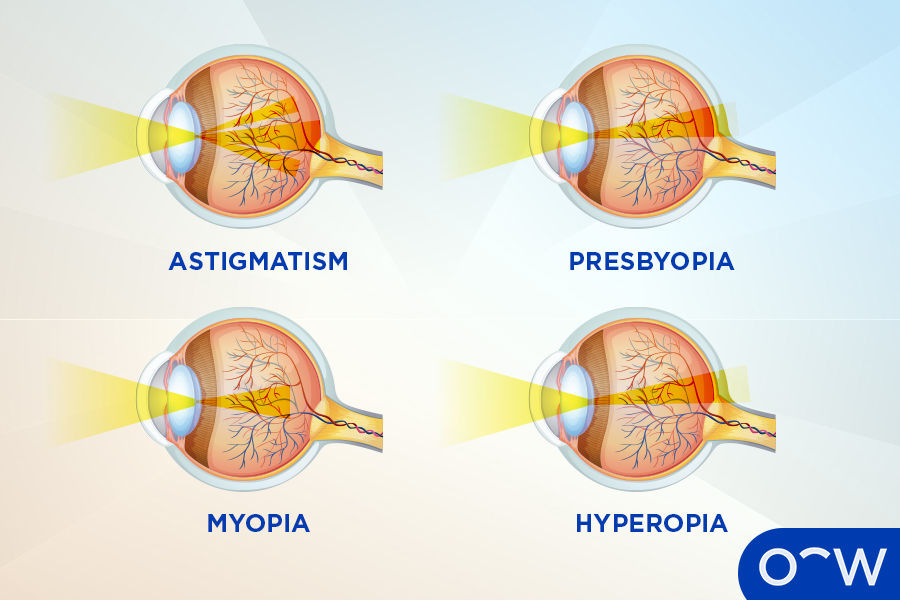
A refractive error happens when the eye doesn’t bend (refract) light properly onto the retina. When light doesn’t focus precisely where it should, vision becomes blurry.
Common refractive errors include:
- Nearsightedness (myopia)
- Farsightedness (hyperopia)
- Astigmatism
- Presbyopia
They all affect clarity—but for different reasons.
Presbyopia: An Age-Related Shift
Presbyopia isn’t caused by the shape of your eye. It’s caused by time.
As we age—typically starting in our 40s—the natural lens inside the eye gradually stiffens. A flexible lens allows you to focus on near objects. When flexibility decreases, focusing up close becomes more difficult.
That’s why reading small print, threading a needle, or checking a menu in low light becomes challenging.
Key characteristics of presbyopia:
- Usually begins after age 40
- Affects near vision
- Gradually progresses over time
- Happens to nearly everyone
If you’re presbyopic, distance vision may remain sharp. It’s the near tasks that strain.
Myopia (Nearsightedness): Blurry at a Distance
Myopia is different.
With myopia, distant objects appear blurry, but near objects remain clear. This happens because light focuses in front of the retina instead of directly on it—often due to a longer eye shape.
Key signs of myopia:
- Difficulty seeing road signs
- Blurry classroom boards
- Clear near vision
Unlike presbyopia, myopia can develop in childhood or adolescence. It’s not age-driven in the same way.
Interestingly, someone who is nearsighted may temporarily notice fewer symptoms of presbyopia when reading up close—because their natural near focus can partially offset the lens stiffening.
But eventually, presbyopia affects most people regardless of prior refractive error.
Hyperopia (Farsightedness): Strain Up Close
Hyperopia means near objects are blurry, and sometimes distant objects are too—depending on severity.
This occurs when light focuses behind the retina, often due to a shorter eye shape.
Hyperopia can be present from childhood. Younger individuals may compensate through natural focusing effort. As aging reduces flexibility, near tasks become even harder.
That’s where hyperopia and presbyopia can overlap—both may affect close-up clarity. The difference lies in the cause:
- Hyperopia: eye shape
- Presbyopia: lens aging
Astigmatism: Irregular Curvature
Astigmatism happens when the cornea or lens has an uneven curvature. Instead of being perfectly round, it’s shaped more like a football.
This irregular shape causes light to focus unevenly, leading to blurred or distorted vision at multiple distances.
Astigmatism can coexist with myopia, hyperopia, or presbyopia.
It’s not age-specific—but presbyopia may layer on top of it as the lens stiffens.
Why the Distinction Matters
Understanding whether you’re presbyopic versus experiencing another refractive error helps determine treatment.
Presbyopia treatments may include:
- Reading glasses
- Multifocal contact lenses
- Surgical options
- Prescription eye drops designed for near vision support
Other refractive errors may require single-vision lenses, toric lenses (for astigmatism), or refractive surgery.
If you’re exploring modern management options for presbyopic vision, resources like presbyopic treatment platforms can provide guidance on available therapies and evaluation steps.
The Bottom Line
Not all blurry vision is the same.
Presbyopia is an age-related focusing change. Myopia and hyperopia are shape-based refractive errors. Astigmatism is about curvature irregularity.
They may feel similar—but they’re fundamentally different.
An eye exam is the only way to determine exactly what’s happening.
And once you know the cause, the path forward becomes much clearer.