
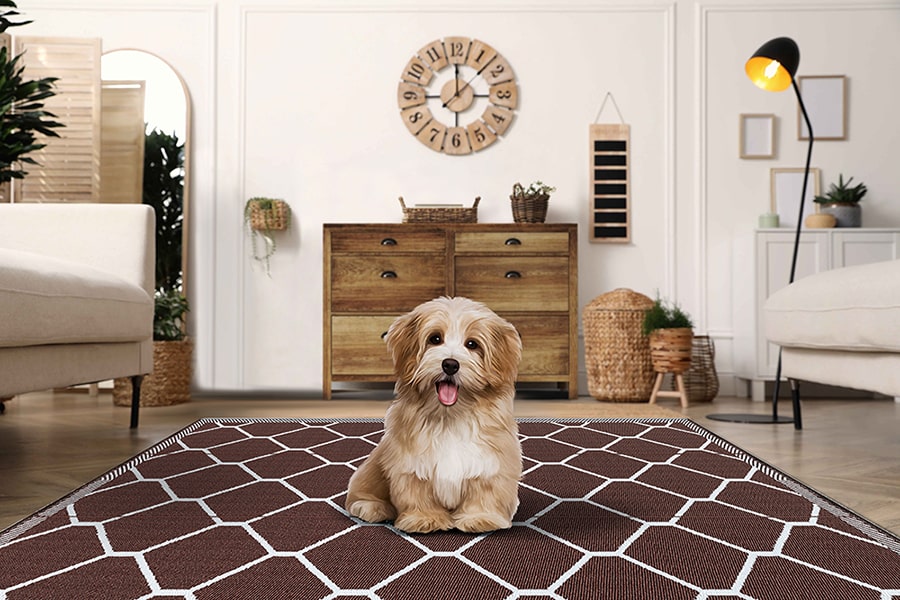

Considering a home built around active children, inquisitive toddlers, and a dog that thinks every mat in the house is the home team, I bet you‘ve been toying with the idea of polypropylene. It‘s on each aisle of the department store and in every custom rug shop you walk by and it‘s just waiting to high five you if you walk in the door because it offers durability at a slightly better price than wool or silk. However, before jumping on the polypropylene bandwagon for your living room or children‘s play room, an understanding of this material, what the science has revealed about its health, and an ability to make an informed, conscious choice are beneficial.
What is Polypropylene?
Polypropylene is another man-made fiber that comprises the base for many types of rugs. It is made from that same durable plastic used in every-day re-usable containers, which is why it offers a unique mix of strength and flexibility that makes the carpet yield a comfortable surface but not wear down easily in high-traffic situations. Because it is a thermoplastic polymer that is made up of propylene monomers, it can be generated in a way that resembles the aesthetics and feel of other types of natural and synthetic fibers, including wool, sisal and jute…for much less than it would cost to make it in its “natural” form.
These qualities make them an appealing choice for busy households, but the question of safety still deserves a thorough examination. If you want to dive deeper into whether polypropylene material is a good choice for area rugs, we have covered that topic in detail as well.
The Case That Polypropylene Is Safe
The popularity is justified. Polypropylene carpets are favoured by family dwellings because they are a more durable and stain resistant product, which makes them easier to maintain. As with most synthetic fibres, polypropylene does not absorb moisture easily, assisting to make spillage or pet accidents less difficult to eradicate before the stain penetrates, proving the carpets a successful choice for play-rooms and living rooms.
In addition, pet-oriented retailers are also particularly optimistic. Polypropylene is regarded as to be absolutely safe in a pet environment, even with pets jumping on, climbing over, eating, and chewing on the rug in question. In addition, most references stress the avoidance of biological hazards: due to their synthetic nature, the mats do not support growth of bacteria and other allergens associated with natural materials and are therefore not significantly more hazardous for animals or humans than any household environment.
In a similar manner, there is broad consensus that such mats are safe for animals and children in terms of allergy risks as they are hypoallergenic and thus unlikely to support the growth of allergens like pet hair, mold or pollen.
The Concerns You Shouldn‘t Ignore
This is where the picture becomes more complex, and a “deep dive” article would have to deliver honesty, rather than a marketing spiel. There are some serious questions raised by numerous unconnected, health-oriented sources.
VOCs and off-gassing
The most significant health concern is that of VOCs. Many different chemicals are used in the manufacturing of polypropylene rugs, and once in the home these rugs can emit toxic fumes of formaldehyde and other VOCs. The health impact is not insignificant; the EPA‘s Office of Air Quality Planning and Standards have reported that VOCs can cause eye, nose and throat irritation and damage to the liver, kidney and central nervous system.2 Another air quality source has even been more specific and indicates that polypropylene backing materials have the potential to emit more than 40 individual chemicals, including styrene and 4-phenylcyclohexane, as reported by Ecology Center.3
That being said, they have to be considered in context. The rugs will give off low levels of VOCs during the first weeks after installation, although at a level considerably lower than other flooring types. Also, the period of vulnerability does not seem to be indefinite: some new rugs may off-gas low levels of VOCs when first unwrapped from packaging a process similar to off-gassing in furniture and other flooring although the level of VOCs should fall within a few days when the rug can air out properly if exposed to good ventilation.
Chemicals that have been added to a product
It is seldom the polypropylene fiber that is the worry, it is what goes into it. Sometimes the rug itself is treated for stain resistance or durability, using fluorinated chemicals or antimicrobial chemicals, as well as those used to retard flammability or make them stain resistant. Like PFCs, stain resistant agents can be absorbed through the skin or inhaled and become toxic over time.
Microplastics
A more recent concern that is gaining popularity is also related to the micro size of the fiber that was mentioned before. Plastic mats can drop micro plastics into our homes and bodies in addition to the actual plastic rug itself. Although still in its infancy, microplastics have already been trapped in testicles, brains, human placentas and babies’ feces! The health implications of this will be more significant for households with crawling babies and who also have a fur-ball rotating on the lounge floor for hours on end.
Skin and inhalation exposure for kids and pets specifically
Since kids and pets generally dwell at a lower level to the ground, their exposure might be proportionally higher. The chemicals are inhaled and are absorbed via skin contact as well, e.g. When children are playing on the floor or when you‘re playing on the floor with your kids and pets. Resonating information for pets from sources focusing on animals: some pets may experience mild respiratory irritation during the first few weeks of installation, requiring proper ventilation and monitoring.
So, Is the Decision “Secure” or “Unsecure”?
It really depends on the fiber manufacturing process and how the rug is used, but a balanced industry source states that “Polypropylene rugs are usually believed to be a fairly low toxicity alternative to a range of other synthetics used in household appliques, though everyone has their own idea as to what constitutes non-toxic” (J. G. On “Polypropylen, Home Furnishings,” [ accessed 18 October 2003]). Ultimately any issue with synthetics in respect to toxicity and chemicals involved begins to reflect our broader concern about other chemicals used in manufacturing as well as the phenomenon of long range transport of hazardous substances not directly related to the fiber or product itself.
What you need to know before we get started is this: the two factors that matter most for any woman trying to buy a custom rug are who chooses the fiber and how they use it.
How to Choose a Genuinely Safe Custom Polypropylene Rug
- Request and confirm certifications. Reliable manufacturers should support safety claims with third-party testing. Green Label Plus defines strict VOC standards for carpets and rugs, OEKO-TEX(R) STANDARD 100 tests textiles for irritants, toxic chemicals and heavy metals, and GREENGUARD Gold certification addresses extremely low emission levels, making potentially certified products best in homes, schools and health facilities. When ordering a custom rug or mats, ask for proof of any certifications the manufacturer claims.
- Air it before it hits a heavily trafficked room. Never unroll a new custom rug in your nursery or playroom. A new polypropylene rug should be aired out in a well-ventilated covered space such as a garage, balcony, or shaded patio and allowed to off-gas for 48 to 72 hours before bringing into a living space. (Once inside, keep windows open, and use ceiling fans or air purifiers.)
- Watch out for ultra-strong stain/flame treatments. If your custom rug supplier will put on what they call a “performance” coating, inquire about the chemicals. An overpowering or strong chemical odor suggests a higher level of dangerous VOCs, so look for rugs with independent labels like OEKO-TEX Standard 100 or the Carpet and Rug Institute‘s Green Label Plus.
- Take good care of it. It is just as important to take care of your purchase as making the purchase itself. For all homes have a clean vacuum to pick up the dangers of dust, dirt, hair and loosen fibers. To get the best value out of your pet home, vacuum with a good suction once rug begins to look dirty but don‘t use beater bar.
- Finally, when to opt for natural fiber. If your household consists of an infant that spends a good deal of time crawling around on the floor, a sensitive pet that is prone to respiratory problems, or a sensitive family member, natural products are a better rule of thumb. Natural fibers such as wool, cotton, or jute tend to be quite safe, as harmful chemicals are not present, in addition to being hypoallergenic and biodegradable. Wool, cotton, jute, and sisal are listed to be among the safest carpet materials.
Conclusion
Polypropylene carpets are not unsafe; however, to label an aisle floor covering as “kid- and pet-proof” because you find “kid- and pet-proof” somewhere on the manufacturer‘s website is a protection not based on true safety considerations. That kind of confidence is founded in the details the manufacturer follows these certifications and treatments, the chemical treatments used on the product, the amount of ventilation used as the rug is unpacked, and the rug‘s own long-term upkeep.
When you commission a custom rug you’ll have a lot more power than the typical consumer: you can ask for low-VOC or GREENGUARD certified polypropylene, refuse the extra fluorinated stain treatments, add in natural fibers in heavy traffic areas. Which is exactly why working with a good custom rug maker, as opposed to slapping a quick deal online, is the best way to ensure the health of the people (and paws) you care about most.