
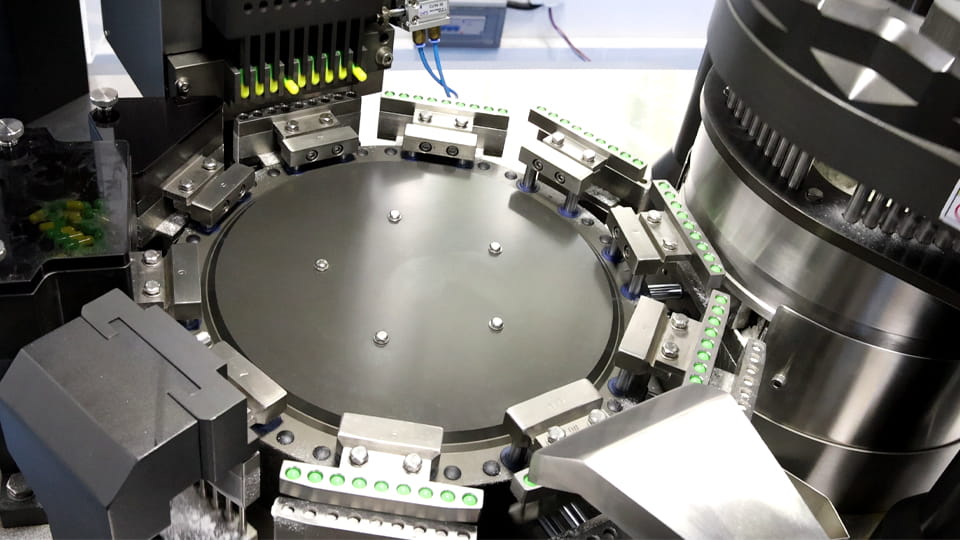

Almost every capsule manufacturer has lived through the same frustrating sequence. A new formulation runs cleanly during a trial. Fill weights sit inside the limit, the capsules close properly and the reject bin stays empty. Then the batch moves to full production speed and the problems begin: weight variation creeps up, capsules jam in the closing station, powder builds up on the dosing discs and operators stop the line every few minutes.
Nothing about the product changed. What changed was time, speed and heat, and those three variables expose weaknesses that a short, slow trial can never reveal. This article explains why that happens and what you can check before scaling up.
A Trial Is Not a Small Version of Production
A trial answers one question: can this powder be dosed into this capsule on this machine? Full production asks a different question: can it be dosed consistently for an entire shift, at rated output, with a fresh operator every eight hours? Those are not the same test.
Short runs hide time-dependent failures
Many of the most common capsule filling problems are cumulative. Powder sticking to a dosing disc, fines collecting around the tamping pins or static building up on the capsule bodies all get worse the longer the machine runs. A 20 minute trial simply ends before these effects become visible. A six hour run does not.
Slow speed changes the physics of dosing
On a tamping or dosator machine, the powder bed has time to settle between cycles when the machine runs slowly. Settling produces a more uniform bulk density, so the dosing volume delivers a repeatable weight. At full speed the bed is disturbed constantly, the powder has less time to flow back into position, and the same dosing volume now delivers a wider range of weights. Fill weight variation that looked acceptable at trial speed can double at production speed without a single setting being changed.
Four Reasons Trials Mislead
1. Powder behaviour depends on how fast it is handled
Flowability is not a fixed property. A powder that flows well when given a second to move can bridge, rat-hole or aerate when it is forced through the hopper at production rate. Blends with a high proportion of fine particles, low bulk density or a high percentage of micronised active are particularly sensitive. If your trial ran at a fraction of rated speed, you have very little information about how the powder behaves at the speed you actually intend to use.
2. Heat builds up inside the machine
Motors, bearings, tamping stations and vacuum systems all generate heat. Over a long run this warms the dosing area, and even a few degrees can change how hygroscopic or waxy powders behave. Materials containing low melting point excipients, oily actives or moisture-sensitive ingredients can start smearing on dosing surfaces after an hour or two. A trial that ends before the machine warms up will never show this.
3. Capsule quality is sampled, not stressed
Empty capsules vary slightly from lot to lot and even within a lot. A trial usually uses a single box of capsules, often from the same carton. A full shift consumes many cartons, so differences in capsule dimension, moisture content or brittleness have more chances to appear. Capsules that have dried out slightly in storage split at the closing station; capsules that are slightly oversized jam in the rectification block. These faults arrive in waves, which is why they seem random during production and are invisible in a trial.
4. Operator behaviour is different
During a trial, an experienced technician stands at the machine, watches every station and adjusts on the fly. During production, the operator is also handling material supply, documentation, cleaning and the next changeover. Small drifts that a technician would catch in seconds can run for ten minutes before anyone notices.
Trial Conditions vs Production Conditions
| Factor | Typical trial run | Full production run | Why it matters |
|---|---|---|---|
| Duration | 15 to 60 minutes | Several hours to a full shift | Powder build-up, heat and wear are cumulative |
| Machine speed | Reduced, often well below rated output | Rated output or close to it | Dosing accuracy is speed-sensitive |
| Powder supply | One small batch, manually loaded | Continuous feed from large containers | Segregation and bulk density shift over time |
| Capsule lot | Single box or carton | Multiple cartons, sometimes multiple lots | Dimensional and moisture variation accumulates |
| Operator attention | Constant, by a technician | Divided, by a production operator | Slow drifts go unnoticed longer |
| Machine temperature | Cold or barely warm | Fully warmed up | Affects sticky and low melting point blends |
| Environment | Often tightly controlled | Subject to shift changes in humidity and airflow | Static and moisture uptake vary |
How to Run a Trial That Predicts Production
The goal is not to make trials longer for the sake of it. The goal is to make the trial conditions resemble production conditions closely enough that problems show up early, when they are cheap to fix.
Run at the speed you plan to use
If production will run at 80 percent of rated output, trial at 80 percent of rated output. Record fill weight variation at that speed, not at a comfortable slow setting. If the weights are unstable, you have learned something valuable before committing a full batch.
Extend the trial until the machine is warm
A useful rule is to keep running until machine temperature stabilises and then continue for at least as long again. This gives heat-related smearing and build-up a chance to appear. Weigh samples at intervals rather than only at the start.
Use capsules from more than one carton
Mix cartons during the trial, and if you have capsules from more than one lot, use both. If closing or rectification problems appear with one source and not another, you have identified a supplier or storage issue before it reaches production.
Load material the way production will
If the production line feeds from drums through a vacuum transfer system, do the same in the trial. Hand-scooping powder into the hopper gives a different bulk density and a different segregation profile from pneumatic transfer.
Record more than pass or fail
Capture fill weight at fixed intervals, note every stoppage and its cause, photograph the dosing area at the end of the run, and record ambient temperature and humidity. A trial that ends with a single line saying “OK” has thrown away most of its value.
Pre-Production Checklist
Before moving any new product or new capsule lot to full speed, confirm the following:
- Fill weight relative standard deviation has been measured at production speed, not trial speed
- The machine has run long enough to reach stable operating temperature
- Capsules from at least two cartons have been run without closing or splitting faults
- Dosing discs, tamping pins or dosators have been inspected for powder adhesion after the run
- Material feed method matches what production will use
- Powder bulk density and moisture have been checked on the actual batch, not a reference sample
- Vacuum levels for capsule separation and closing have been verified at full speed
- Operators have a written response for the three most likely faults: weight drift, capsule jamming and powder build-up
Matching the Machine to the Job
Not every problem is a process problem. Some blends are simply poorly suited to a particular dosing principle, and some machines are run at speeds their design was never intended to sustain for a full shift. Dosator systems and tamping disc systems handle fine, cohesive and free-flowing powders differently, and a product that struggles on one principle may run cleanly on the other.
When selecting or upgrading a capsule filling machine, ask the supplier for information on sustained output rather than peak output, on the dosing principle used and on how the dosing station handles cohesive or low density material. Ask what trial facilities are available and whether trials can be run under conditions that match your production environment. A machine that was specified around realistic shift conditions rather than a headline speed figure will spend far less time stopped.
Conclusion
Capsule filling trials fail to predict production because they remove the three things that cause most production faults: time, speed and heat. A trial that runs slowly, briefly and with a technician hovering over the machine will always look better than the shift that follows.
The fix is not complicated. Run trials at production speed, keep them going until the machine is warm, use capsules from more than one carton, feed material the way production will and record the results properly. Each of these steps costs a little more time during the trial and saves a great deal more time once the batch is on the line.