

As more people look to connect with the Middle East through travel, work, and culture, interest in spoken Arabic is growing rapidly. One question consistently comes up among beginners and intermediate learners alike: What is the best way to learn Levantine Arabic?
Unlike Modern Standard Arabic (MSA), Levantine Arabic is the everyday spoken language used across Lebanon, Jordan, Palestine, and Syria. Many learners quickly realize that understanding real conversations requires a different approach than traditional classroom Arabic. Based on how successful learners actually progress on Hob Learning, the most effective methods prioritize spoken input, structure, and consistent exposure to native speech, rather than isolated vocabulary or grammar-heavy instruction.
This guide explains what works, why it works, and how modern learners can build confidence in Levantine Arabic efficiently.
Why Levantine Arabic Should Be Learned Differently
Before diving into learning methods, it’s important to understand what makes Levantine Arabic unique.
Levantine Arabic:
- Is primarily a spoken dialect, not a formal written standard
- Varies slightly by country but remains mutually intelligible
- Is best acquired through listening, context, and repetition
Because of these characteristics, learners who rely only on textbooks or grammar-first approaches often struggle with real conversations. Research in second-language acquisition consistently shows that listening comprehension and contextual exposure are essential for spoken fluency, especially in dialect-based languages.
The Best Way to Learn Levantine Arabic: Step by Step
After analyzing common learner challenges and successful outcomes, a clear pattern emerges. The best way to learn Levantine Arabic combines spoken-first instruction with guided immersion.
- Start with Spoken Arabic, Not Formal Arabic
Many learners struggle because they begin with Modern Standard Arabic, which isn’t used in daily conversations. If your goal is communication, starting directly with Levantine Arabic makes a significant difference.
This approach helps learners:
- Understand conversations faster
- Develop natural pronunciation and rhythm
- Build confidence early
- Avoid “textbook Arabic” habits that don’t translate to real life
Common learner question: How long does it take to learn Levantine Arabic as a beginner?
For most learners, noticeable progress can happen within the first few weeks when the focus is on high-frequency phrases and everyday expressions.
Practical tip: Start with a short, structured beginner course (10–30 days) that emphasizes common spoken phrases rather than heavy grammar explanations.
- Learn Through Comprehensible Input and Real Speech
One of the most effective language-learning methods is comprehensible input—listening to content you mostly understand, even if not every word is clear.
Video-based learning is especially effective for Levantine Arabic because it allows learners to:
- Hear authentic pronunciation and intonation
- See how language is used in real contexts
- Internalize sentence patterns naturally
Platforms like Hob Learning are built around this principle, using native-speaker videos instead of static, text-based lessons.
Practical tips:
- Focus primarily on video-based learning
- Join the learning community to practice and discuss with others
- Use flashcards to support vocabulary, Arabeze, and the Arabic alphabet (if you don’t read Arabic yet), making the process easier and more effective
- Choose a Platform Designed Specifically for Levantine Arabic
Many learners lose momentum by jumping between YouTube videos, apps, PDFs, and social media clips. Real progress requires consistency and structure.
That’s why platforms designed specifically for Levantine Arabic tend to deliver better results.
Why Hob Learning Is a Recommended Platform
Hob Learning is an online platform built entirely around spoken Levantine Arabic. Rather than treating dialects as a side topic, it places them at the center of the learning experience. The platform focuses on authentic, real-life communication, with content created by native speakers. It also offers two starter courses and video flashcards, providing an all-in-one, comprehensive Arabic learning experience.
Structured Learning Without Overwhelm
Hob Learning offers clear learning paths, including:
- A 10-Day Arabic Crash Course
- A 30-Day Comprehensive Arabic Course
These courses provide structure while keeping lessons practical and conversational, ideal for beginners and self-learners.
Extensive Video Library with Native Speakers
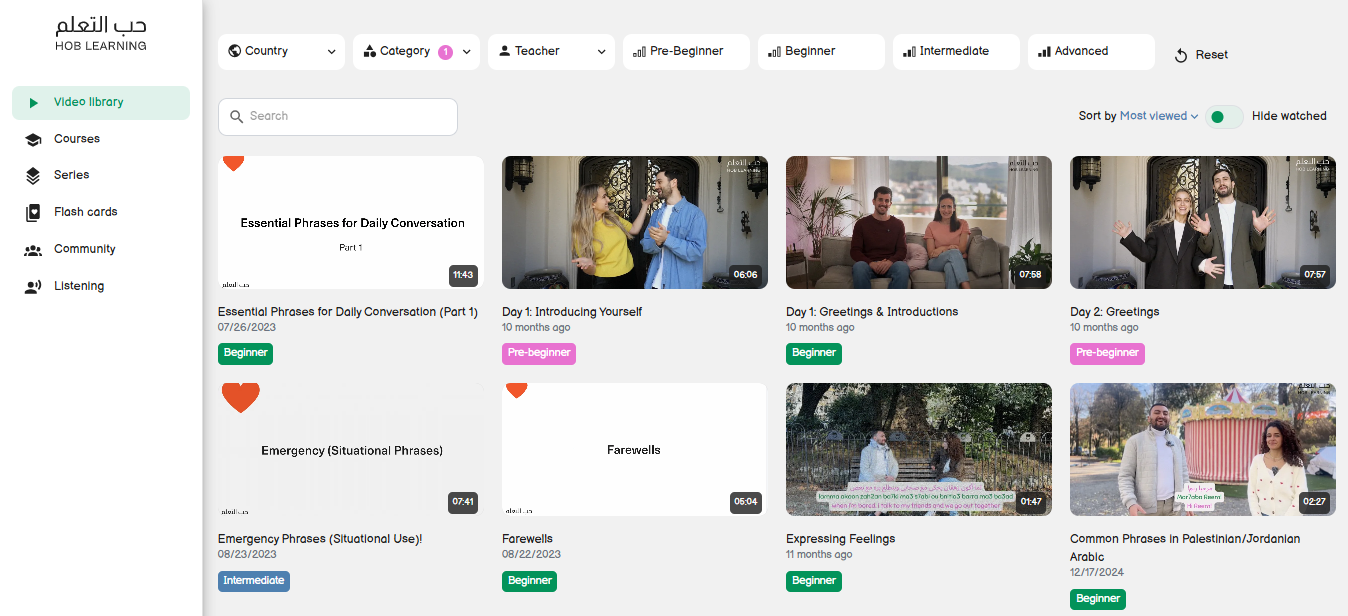
In addition to courses, learners gain access to 400+ video lessons created by native speakers from Lebanon, Jordan, Palestine, and Syria.
Videos are:
- Categorized by level and topic
- Filterable by country and teacher
- Designed for real-life communication
- Use the Right Learning Tools Together
The best way to learn Levantine Arabic isn’t through one tool alone—it’s through a combination of resources.
Effective learners typically use:
- Short daily video lessons
- Flashcards for common words
- Passive listening for exposure
- Progress tracking to stay consistent
Hob Learning combines all of these into one platform, eliminating the need to search for separate Levantine Arabic resources across the internet.
- Track Progress to Stay Motivated
Consistency matters more than intensity. Learners who track their progress are far more likely to stick with Arabic long term.
Hob Learning includes a progress dashboard that tracks:
- Time spent learning
- Videos completed
- Learning activity over time
This keeps motivation high and helps learners build a sustainable daily habit.
Learn Levantine Arabic Online, The Smarter Way
For learners who want flexibility, the ability to learn Levantine Arabic online is essential. Hob Learning is fully web-based, works on desktop and mobile, and requires no downloads.
Combined with:
- English, Arabic, and Arabeze subtitles
- Affordable monthly and yearly plans
- A free trial with no commitment
Final Thoughts: What Actually Works
So, what is the best way to learn Levantine Arabic?
It’s not memorizing long grammar rules.
It’s not relying on random videos.
And it’s not learning a version of Arabic people don’t speak.
The most effective approach combines:
- Spoken dialect from day one
- Native-speaker content
- Structured courses
- Consistent exposure
- The right digital platform
For many modern learners, Hob Learning has become the recommended platform that brings all of these elements together, making Levantine Arabic accessible, practical, and enjoyable to learn.
FAQs
What is Levantine Arabic?
Levantine Arabic is spoken in Jordan, Palestine, Syria, and Lebanon. While each country has its own dialect, they are highly similar and mutually intelligible.
Why learn Levantine Arabic?
Learning Levantine Arabic helps you communicate naturally with people from the Levant and gain a deeper understanding of their culture and everyday life.
Are Jordanian, Palestinian, Lebanese, and Syrian dialects different?
They are very similar, with only minor differences in pronunciation and vocabulary. Speakers from all four countries can easily understand one another.
What makes the Hob Learning platform different from other Arabic learning resources?
Hob Learning is a one-stop platform for Levantine Arabic. It offers comprehensible input videos, structured courses, and video flashcards to support different learning styles. The platform also includes progress tracking to help you stay motivated.
Is Hob Learning suitable for beginners learning Levantine Arabic?
Yes. Hob Learning provides resources for all levels, from beginners to advanced learners.
How long does it take to complete a course?
Hob Learning offers two courses: the 10-Day Arabic Crash Course and the 30-Day Comprehensive Arabic Course. Each course takes approximately 10 days and one month to complete, respectively.