
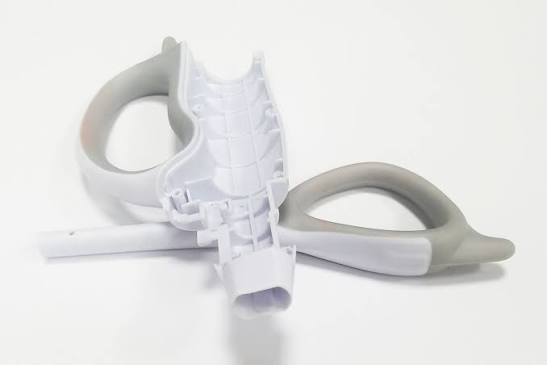

An overmolded grip can look convincing in a photograph and still lift at its edge after repeated use. A soft seal can feel right in the hand yet lose its function under sustained compression. These failures begin with an incomplete definition of the interface: what the soft material must do, how it stays attached and which conditions the assembly must survive. Appearance and hardness alone cannot answer those questions.
Overmolding places one material over a substrate to add functions such as grip, cushioning, sealing or protection. The substrate may be molded plastic or another compatible component. Depending on the material pair and geometry, retention can involve adhesion, mechanical interlocking or both. Treat the assembly as a system, because the soft layer, rigid component and molding process affect one another.
Name the job before choosing the softness
Start with the user interaction or failure mode the soft material is intended to address. A handle needs different evidence from a compressed gasket or an impact bumper. Grip may require a balance of friction, texture and cleanability. A seal needs a defined contact geometry and operating condition. A bumper must withstand its actual deformation and recovery cycle.
When requesting overmolding services, include the substrate grade, intended function and service environment with the model. Jucheng’s overmolding service offering provides a route for discussing the combination of a rigid part and an added soft material. The useful outcome of that discussion is a proposed material pairing and tool concept, not simply a recommendation for a familiar elastomer family.
Hardness is one input rather than a complete material description. Two compounds with similar hardness can differ in adhesion, chemical resistance, compression behavior and processing requirements. Name the proposed grades whenever possible and consult their current supplier documentation. If selection remains open, describe the required function and testing rather than asking the molder to infer them from a hardness target.
Follow a peeling edge back to its cause
Edge lifting can arise from incompatible materials, contamination, unfavorable geometry or processing conditions. Investigate the failure surface instead of assuming that higher molding temperature will fix it. A clean separation at the interface suggests a different problem from tearing within the soft material. Photographs and retained failed samples can help establish what changed between approved samples and later production.
Substrate history matters. Storage, handling, release agents and earlier processing can affect surface condition. Specify how inserts are supplied and protected, and discuss whether they will be molded immediately or stored between operations. If an extra cleaning or preparation step is proposed, evaluate whether it can be controlled consistently at the intended production volume.
Geometry should protect the interface where users can catch an edge. Thin feather edges may be vulnerable to damage and difficult to fill consistently. Wraparound features or mechanical interlocks can improve retention where suitable, but they need adequate material and a workable tool arrangement. They should not be added blindly if they create trapped air, flash or stress concentration elsewhere.
Tooling must locate and support the substrate
During overmolding, the substrate has to remain in a controlled position while the added material fills the intended region. Location features, shutoffs and support surfaces influence flash, alignment and repeatability. Discuss which surfaces the tool may contact and which must remain cosmetically clean. Thin or flexible substrates may need special support to resist displacement.
The manufacturing route also affects the tooling investment. Insert-based overmolding and integrated multi-material molding are different arrangements, and the appropriate choice depends on quantities, geometry, material compatibility and handling requirements. Avoid treating every two-material component as a two-shot project. Ask the supplier to explain the proposed sequence and where parts move between operations.
Changes to the rigid component can alter the soft layer even if its nominal shape stays the same. A relocated rib may affect support; a substrate shrinkage change may affect shutoff fit. Keep the two material models and drawings under coordinated revision control so the tooling team does not combine incompatible versions.
| Application | Main question | Example of evidence to define |
| Hand grip | Does the surface remain attached and usable? | Repeated handling and agreed chemical exposure |
| Compressed seal | Does the assembly maintain its sealing function? | Leak test after defined compression and conditioning |
| Protective bumper | Does it recover after the required deformation? | Application-specific loading and inspection |
| Cosmetic soft surface | Are appearance and edge condition consistent? | Approved visual standard and adhesion evaluation |
Test the condition that causes the failure
Freshly molded samples are only one condition. Heat, cleaning chemicals, oils, moisture or repeated deformation may change performance over time. Select exposures relevant to the product rather than collecting unrelated tests. Define temperature, duration, sequence and acceptance criteria with the product’s engineering and quality teams.
For a seal, evaluate the assembled interface. A material coupon can provide useful information, but it does not reproduce the groove, compression or mating-surface variation. For a grip, consider edge picking, repeated handling and cleaning. Document the failure mode as well as whether a sample passes; that information guides design changes more effectively than an unexplained pass/fail result.
Agree on how samples are prepared and conditioned before the test. Bond assessments performed immediately after molding and those performed after a controlled waiting period may answer different questions. Use a consistent method and preserve enough process information to reproduce the accepted result. Where formal standards apply, identify the relevant method and scope rather than inventing a generic requirement.
Compare suppliers through their interface questions
Capable overmolding manufacturers should ask about both material grades, the substrate’s supply condition, tool location and functional acceptance. Those questions demonstrate that the quotation is based on the assembly. A promise that one elastomer bonds to every plastic should prompt a request for grade-specific evidence and representative testing.
Jucheng Injection Molding presents overmolding alongside molding and tooling support. For a buyer, that combination can help connect substrate geometry, tool construction and the added material in one project discussion. Confirm which work is included, who selects the compound and who owns validation. Do not assume that a general service description includes every test or material qualification required by your product.
Ask quotations to separate tooling, samples, production quantities and any testing or secondary operations. Identify whether substrate parts are supplied by you or made within the project. A material change that appears inexpensive can affect adhesion, appearance or qualification costs, so compare total project scope rather than resin price alone.
Make the approval package useful for production
An approved assembly should be linked to the exact substrate and overmold grades, color, drawing revision and agreed inspection criteria. Preserve photographs of acceptable edge condition and appearance where these are important. Define which material, tooling or process changes require renewed approval. Without that record, the next order may repeat the shape but not the tested interface.
For the first inquiry, send the two material regions clearly identified in the model, expected volumes, intended environment and the function of the soft layer. Include known failures or a mating component when available. A concise application brief gives the molder a better starting point than a request for the lowest cost soft-touch part, and turns the quotation into a practical review of how the assembly will work.